

Arranging treatment abroad often begins long before a flight is booked. One of the most important early steps is preparing a clear, complete and well-organised medical record. When documents are incomplete, duplicated or difficult to understand, communication with healthcare providers may be delayed, and patients may be asked to provide further information.
This practical checklist explains how patients and families can organise their medical information before requesting an opinion or quotation from a healthcare provider abroad.
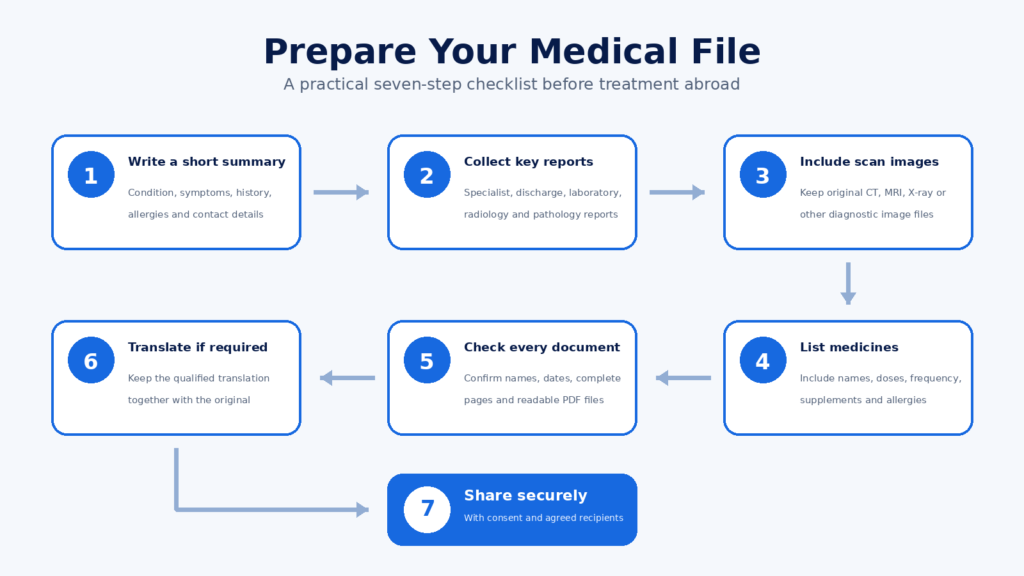
1. Start With a Short Medical Summary
Prepare a one-page summary containing:
- The patient’s full name, date of birth and contact details
- The main medical condition or concern
- Important previous diagnoses and procedures
- Current symptoms and their duration
- Relevant allergies
- Current medicines, including doses
- Other significant health conditions
The summary should be factual and concise. It does not replace formal medical reports, but it helps the receiving healthcare provider understand the case quickly.
2. Collect the Most Relevant Medical Reports
Gather reports connected with the current condition, such as:
- Consultation and specialist reports
- Hospital discharge summaries
- Operation or procedure reports
- Laboratory results
- Radiology reports
- Pathology or biopsy reports
- Treatment records and follow-up notes
Arrange them from newest to oldest or in chronological order. Avoid sending large numbers of unrelated documents unless the healthcare provider requests them.
3. Include Diagnostic Images Where Available
For X-rays, CT scans, MRI scans, ultrasound examinations or other imaging, the written report may not always be sufficient. The healthcare provider may also request the original images, commonly supplied on a CD, USB drive or through a secure digital link.
Keep the images in their original medical format where possible. Do not convert, alter or edit diagnostic images yourself.
4. Prepare an Accurate Medication List
Write the name, strength and frequency of every current medicine. Include prescription medicines, over-the-counter products, vitamins and supplements. Also record any known medicine or food allergies and the type of reaction experienced.
An accurate list reduces confusion and allows the licensed healthcare professional to consider this information when reviewing the case.
5. Check Names, Dates and Readability
Before submitting the file, check that:
- The patient’s name is consistent across the documents
- Dates are clearly visible
- Scans are upright and readable
- Every page is included
- Duplicate and unrelated pages have been removed
- Password-protected files can be opened by the intended recipient
Clear PDF files are usually easier to manage than multiple photographs sent through messaging applications.
6. Translate Documents When Required
Ask the receiving healthcare provider whether documents must be translated. If translation is necessary, use a qualified translator and keep both the original document and its translation together. Do not alter the original medical report.
7. Protect Confidential Information
Medical records contain sensitive personal information. Send them only through an agreed and appropriately secure method. Confirm who will receive the documents, why they are required and whether patient consent is needed before information is shared with another person or organisation.
Avoid publishing medical reports in public groups or forwarding them to people who are not involved in the coordination or care process.
How MedRACE Can Support the Process
MedRACE can provide non-clinical assistance with collecting and organising relevant records, communicating stated requirements to healthcare providers, obtaining provider-supplied information, and coordinating appointments and practical arrangements.
MedRACE does not interpret medical reports, provide diagnosis or recommend treatment. Clinical assessment and treatment decisions remain between the patient and the chosen licensed healthcare provider.
A Well-Prepared File Saves Time
An organised medical file does not guarantee acceptance for treatment, a particular clinical opinion or a specific cost. It does, however, help healthcare providers review the available information more efficiently and identify whether further reports, tests or consultations may be required.
If you are considering treatment within Bahrain or abroad, contact MedRACE to discuss the non-clinical coordination support available.